
What to Expect in Trauma Treatment
If you’re thinking about trauma treatment, your questions probably go beyond which therapies are offered. What will you actually do all day? Will you have to talk about the worst things that ever happened to you, right away, in front of people you just met? Will it feel safe?
Those are fair questions, and you deserve honest answers before you commit to anything. This page walks you through what a trauma treatment program looks like from the inside at Tranquil Palms: how your days are structured, what happens in individual and group sessions, what common trauma therapies feel like in practice, and how a women-only setting supports the work.
Here’s the most important thing to know up front. Trauma treatment is not about reliving your past on demand. It’s about helping your nervous system learn that it’s safe now, building skills that make hard feelings more manageable, and working through what happened at a pace you can handle.
Find out if your insurance will cover the cost of treatment.
"*" indicates required fields
Your First Few Days in Treatment
Your first days are about getting your bearings, not diving into your trauma history. Most of this time is spent helping your team understand what you need and helping you feel oriented in a new place.
- Your admissions call: It starts with a confidential conversation, available 24/7, where you can ask questions and verify your insurance. Nothing is decided for you on that call.
- Your assessment: A clinician talks with you about your mental health, substance use, physical health, and goals. You’ll be asked about trauma, but only at the level you’re ready to share. Your team needs to understand what you’re carrying, not every detail of it.
- Meeting your care team: You’ll meet your primary therapist and other members of your team, which may include psychiatric and program staff.
- Orientation: You’ll learn your schedule, how groups work, and, if you’re using a live-in option, how supportive housing fits into your day.
- Your treatment plan: Your plan is built with you, not handed to you. It reflects your history, your goals, and what feels manageable right now.
It’s normal to feel nervous, guarded, or worn out in these first days. Many women say the hardest part was walking in the door. You don’t have to arrive feeling ready. You only have to arrive.
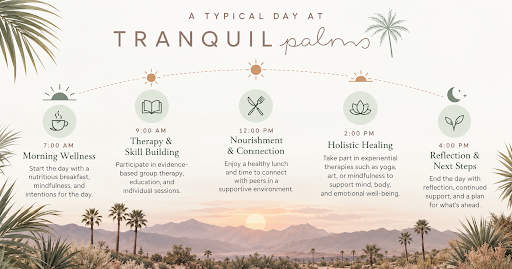
What a Typical Day Looks Like
Trauma treatment at Tranquil Palms follows a steady daytime structure, and that structure is part of the care. When your days are predictable, your nervous system doesn’t have to stay on guard for what’s coming next.
How much time you spend in programming depends on your level of care:
- Phase 1, partial hospitalization program (PHP): The most structured stage. You attend programming for several hours a day, most days of the week, while you stabilize and begin building skills.
- Phase 2, intensive outpatient program (IOP): You step down to fewer hours, with more room to practice what you’ve learned in daily life, at home, at work, or with family.
No two days are identical, but a day in PHP might look something like this:
|
Part of the day |
What you might be doing |
|
Morning |
A check-in group to name how you’re arriving, followed by a grounding or mindfulness practice |
|
Late morning |
A women’s process group or a skills group focused on things like emotion regulation |
|
Midday |
A break to eat, rest, and reset |
|
Afternoon |
Individual therapy, a psychiatric appointment, or a recovery education group |
|
Late afternoon |
A wellness practice such as breathwork or gentle movement, then a short wrap-up before you leave |
|
Evening |
Time at home, or at supportive housing if you’ve chosen a live-in option |
In IOP, the same kinds of sessions happen in a shorter block, so treatment fits around more of your life.

The Types of Sessions You'll Take Part In
Most of your week is a mix of one-on-one and group work. Each type of session does something different, and together they give you more than one way to heal.
Individual Therapy
Individual therapy is where most of the deeper trauma work happens. You meet one-on-one with your primary therapist, who gets to know your history, your triggers, and the ways you’ve learned to survive. You decide together what to work on and how fast. If a session gets to be too much, you can slow down or stop.
Women’s Process Groups
In process groups, a small group of women talks through what’s coming up in treatment and in life. You can share as much or as little as you want. Many women find that hearing someone else describe a feeling they thought was theirs alone is one of the most healing parts of treatment. You won’t be asked to tell your trauma story in detail in front of the group.
Skills and Recovery-Focused Groups
These groups feel closer to a class. You learn practical tools for managing emotions, handling triggers, preventing relapse, and understanding how trauma affects the body and mind. Then you practice them, in group and between sessions.
Psychiatric Care
If sleep problems, anxiety, depression, or other symptoms are making it hard to function, a psychiatric provider can evaluate whether medication might help. This is a conversation, not a requirement. Some women use medication as part of treatment and some don’t.
Wellness Practices
Trauma lives in the body as well as the mind. Practices like mindfulness and grounding, breathwork, meditation, gentle movement, and nutrition-informed guidance help you reconnect with your body in a way that feels safe, at your own pace.
What Trauma Therapies Feel Like in Practice
You may have read the names of these therapies on a website. Here’s what they’re actually like to sit through. Your team will talk with you about which approaches fit your needs, and many women use more than one.
Cognitive Processing Therapy (CPT)
CPT focuses on the beliefs trauma can leave behind, like “It was my fault,” “I should have stopped it,” or “I can’t trust anyone.” In sessions, you and your therapist look closely at those beliefs and ask whether they hold up. It can feel a little like detective work on your own thinking.
You’ll often use short worksheets and practice between sessions. Some versions of CPT include writing about what happened, but that’s discussed with you ahead of time, not sprung on you. Many women describe a quiet shift: the memory is still there, but the shame attached to it starts to loosen.
Cognitive Behavioral Therapy (CBT)
CBT is practical and present-focused. You learn to notice how your thoughts, feelings, and actions feed into each other, especially when you’re triggered. You might track moments when anxiety spikes, identify the thought underneath it, and try a different response.
It can feel structured and goal-oriented, with small, concrete steps from week to week. For many women, that structure is a relief. It gives you something to do with feelings that used to feel out of control.
Dialectical Behavior Therapy (DBT)
DBT is skills-based, and it often feels like learning a new toolkit. Skills fall into four areas:
- Mindfulness: Staying present instead of getting pulled into the past or into worry
- Distress tolerance: Getting through a crisis or an urge to use without making things worse
- Emotion regulation: Understanding your emotions and lowering their intensity
- Interpersonal effectiveness: Asking for what you need and setting boundaries
DBT can be especially helpful if your emotions tend to feel overwhelming, or if you’ve used substances to cope with them. You learn a skill in group, practice it during the week, and talk through what worked.
What Processing Trauma Actually Looks Like
“Processing” can sound intimidating, as if it means reliving everything at once. In trauma-informed care, it’s a gradual process that usually moves through three broad stages:
- Safety and stabilization: Before anything else, you build steadiness. That means grounding skills, better sleep and routine, support for substance use, and enough trust in your team to go further.
- Working through what happened: Once you have tools to stay steady, you and your therapist begin looking at the trauma itself and the beliefs and patterns it left behind. This happens in small pieces, not all at once.
- Integration and moving forward: You start to fold what you’ve learned into daily life, relationships, and your plans for after treatment.
These stages aren’t a rigid checklist. You might circle back to stabilization during a hard week, and that’s part of the process, not a setback.
A few things stay true throughout:
- You set the pace: Your therapist watches for signs that you’re becoming overwhelmed and helps you come back to the present.
- You have a say: You can ask questions, pause, or say “not today.” Choice is built into trauma-informed care.
- Sessions end with care: Hard sessions usually close with grounding, so you don’t walk out feeling raw and alone.
It’s common to feel tired, emotional, or unsettled after a deep session, or to notice more vivid dreams for a while. That doesn’t mean something is wrong. Tell your team what you’re noticing so they can adjust your pace and support.
When Trauma and Substance Use Overlap
Many women who come to trauma treatment have also used alcohol or drugs to cope. If that’s you, it doesn’t mean you failed. Substances often work, for a while, to quiet hypervigilance, numb painful memories, or make it possible to sleep.
The problem is that trauma and substance use tend to feed each other. That’s why they’re treated together rather than one after the other. In practice, your sessions will connect the two: you’ll look at what you were trying to soothe, learn other ways to get through those moments, and build a relapse prevention plan that accounts for your triggers.
If you’re also living with depression, anxiety, or another mental health condition alongside substance use, you can learn more about our dual diagnosis treatment.
How the Environment Supports Your Healing
Where you heal matters almost as much as how. Trauma can leave your body scanning for danger, so the setting itself is designed to help you settle.
- A women-only environment: Every client in the program is a woman. For many women, especially those whose trauma involved men, that removes a layer of tension and makes it easier to speak openly in group.
- A calm, private setting: The program is based in a quiet part of Palm Desert, away from the pressures and reminders of daily life.
- Predictable structure: Knowing what each day holds gives your nervous system fewer surprises to manage.
- Optional live-in support: If home isn’t a stable or supportive place right now, you can choose supportive housing while you attend PHP or IOP.
- A trauma-informed team: Staff are trained to offer choice, explain what’s happening and why, and respond to distress with patience rather than judgment.
Over time, many women notice that feeling safe stops being something they have to force. It starts to become familiar.
Hard Days, Small Shifts, and What Progress Looks Like
We’d rather be honest with you: trauma treatment isn’t easy, and some weeks may feel harder before they feel better. Facing things you’ve worked hard to avoid takes energy. That’s a sign the work is reaching something real, not a sign it isn’t working.
Progress in trauma treatment is often quieter than people expect. It might look like:
- Sleeping a little more through the night
- Noticing a trigger before it takes over
- Using a grounding skill instead of reaching for a drink
- Saying something out loud in group that you’ve never said before
- Catching yourself in an old belief and questioning it
As you stabilize, you’ll step down from PHP to IOP, and your team will help you plan for life after treatment. Recovery timelines are personal. There’s no right speed, only the pace that works for you.
Frequently Asked Questions About Trauma Treatment
How Does Trauma Therapy Work?
Trauma therapy helps your brain and body process experiences that got “stuck” instead of being filed away as past events. It usually starts by building safety and coping skills, then gradually works through the memories and beliefs connected to the trauma. Approaches like cognitive processing therapy, cognitive behavioral therapy, and dialectical behavior therapy each do this in a slightly different way.
How Long Does Trauma Treatment Take?
It depends on your history, your symptoms, and how you respond to care. Some women spend several weeks in PHP before stepping down to IOP, and others need more time. Your team will review your progress with you regularly and adjust your plan as you go.
Will I Have to Talk About My Trauma in Detail?
Not right away, and not without your agreement. Early treatment focuses on safety and stabilization. When you do begin working on the trauma itself, you and your therapist decide together how much detail is helpful, and you can pause at any point.
What If I Get Triggered During Treatment?
It may happen, and your team is prepared for it. Being triggered in a supported setting is very different from being triggered alone. Staff will help you ground, figure out what set it off, and build a plan for handling similar moments in the future.
Do I Need a PTSD Diagnosis to Start Trauma Treatment?
No. You don’t need a formal diagnosis to reach out. Your assessment helps determine what you’re experiencing and which level of care fits. Many women in trauma treatment have symptoms that don’t fit neatly into one label.
Is Trauma Treatment Covered by Insurance?
Many insurance plans cover trauma treatment, but coverage varies by plan, level of care, and medical necessity. The quickest way to know is to verify your insurance or call our admissions team at (760) 867-0116.
Take the Next Step When You're Ready
You don’t need to have everything figured out to start. You don’t need to know exactly what happened to you, what to call it, or whether you’re “bad enough” for treatment. You only need to be curious about whether things could feel different.
To learn more about how care is structured, levels of care, and who we serve, explore our women’s trauma treatment program. When you’re ready to talk, our admissions team is available 24/7 at (760) 867-0116, or you can verify your insurance coverage online. Every conversation is confidential.